Is the Piper Cherokee Actually the Better Trainer?
The Other Airplane Almost Every Pilot Knows
The difference is striking.
While some pilots are ducking under a wing and behind a strut to climb into a Cessna, other pilots are stepping up onto the wing of a Piper Cherokee before lowering themselves into the cabin.
Spend enough time around general aviation and you will almost certainly encounter both.
The Cessna 172 may be aviation's default trainer, but the Piper Cherokee and its descendants have spent more than six decades giving it some very serious competition.
Piper introduced the PA-28 Cherokee in 1961. The basic design would eventually grow into an enormous family of airplanes, including the Warrior, Archer, Dakota, and Arrow.
And somewhere along the way, pilots developed one of those friendly aviation arguments that may never actually be settled:
Which is better—the Skyhawk or the Cherokee?
The sides can become surprisingly entrenched.
Having flown and instructed in both, I think the Cherokee makes a very strong case.
Just not quite a strong enough one.
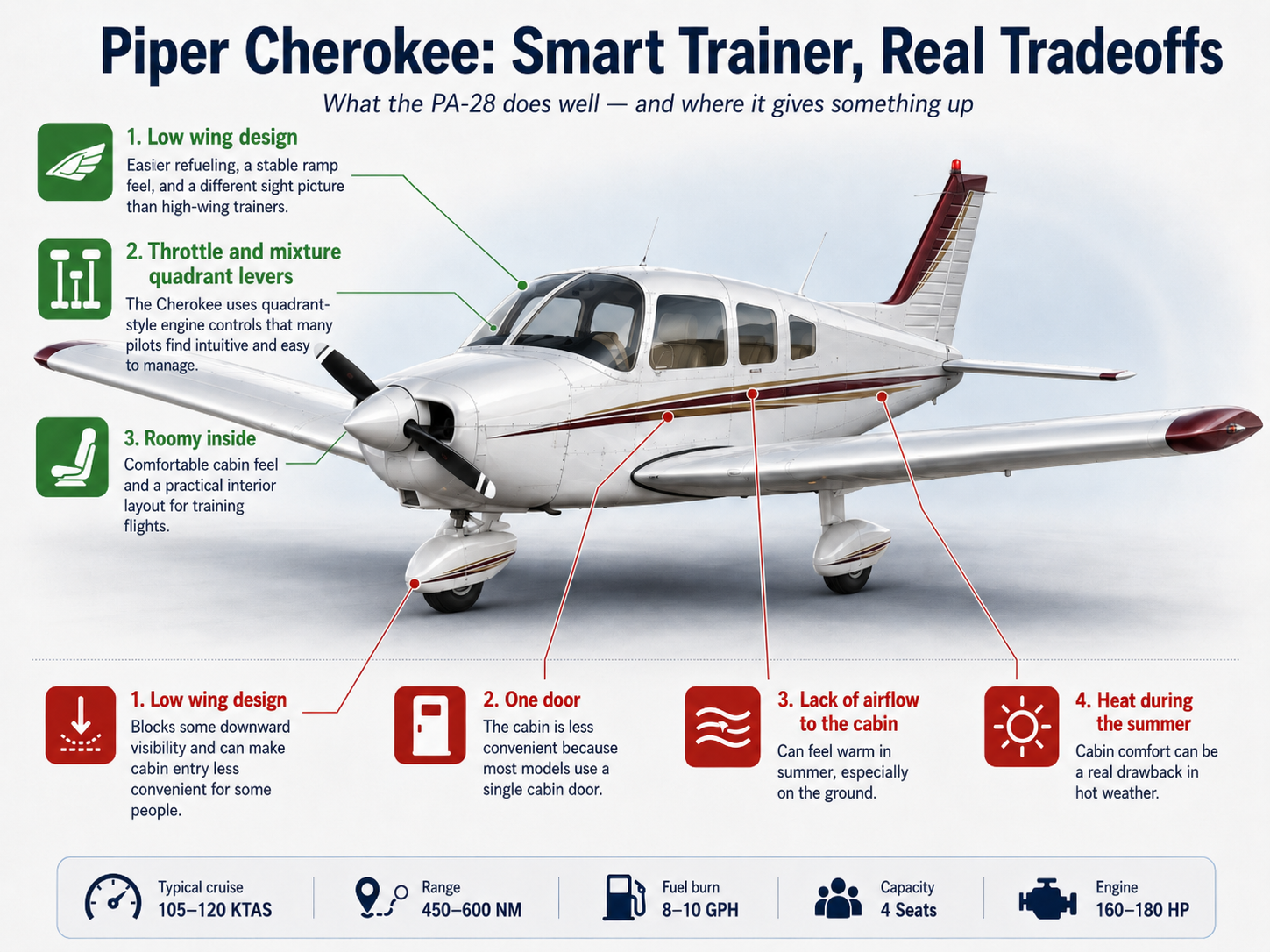
Low Wing, Different Personality
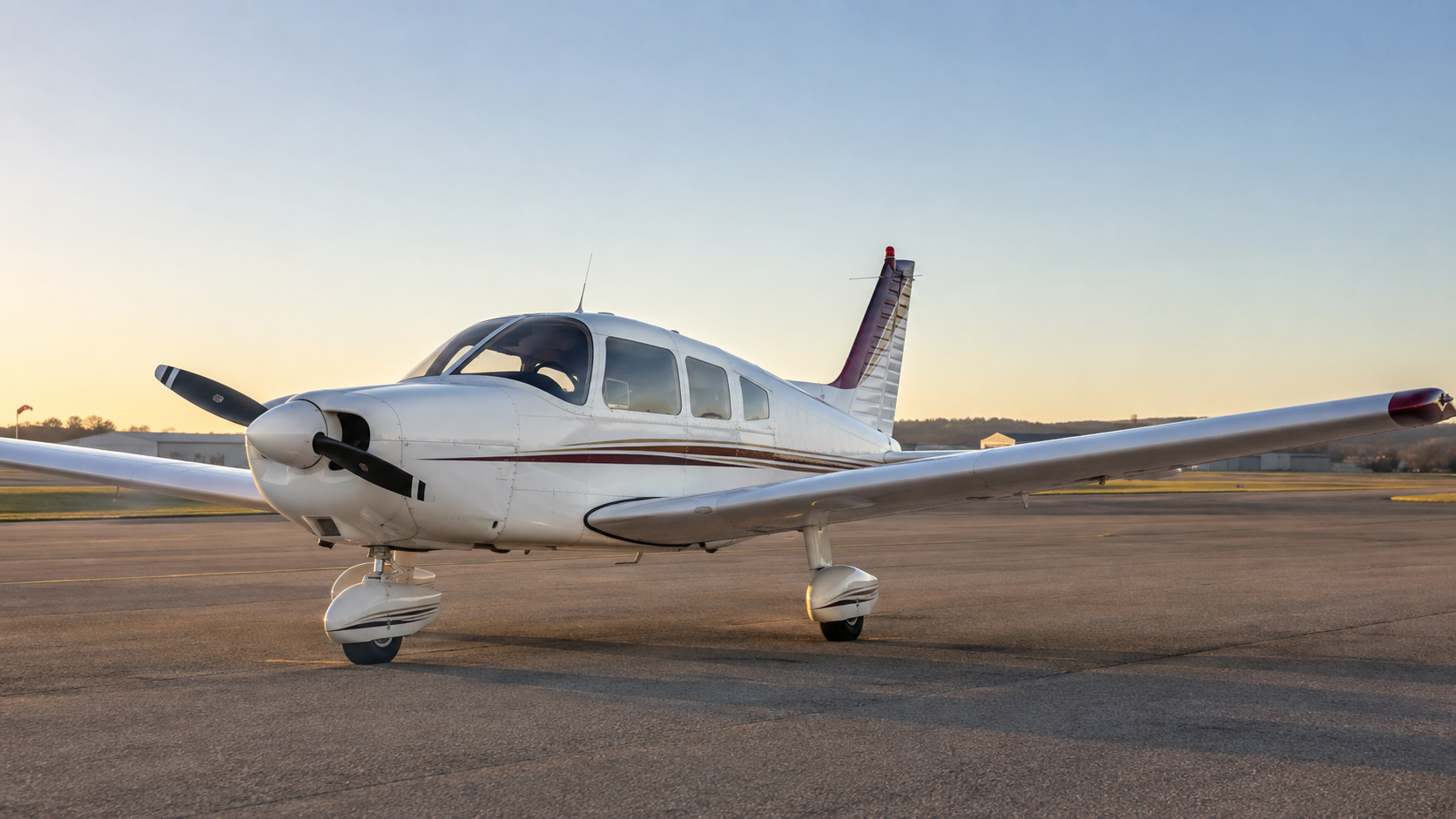
The most obvious difference is the wing.
The Cherokee puts it below you.
That changes both the experience of flying the airplane and the experience of dealing with a low wing on the ground.
One advantage becomes obvious the first time you fuel one.
There is no ladder.
There is no climbing onto a strut.
The fuel caps are right there on the wing where you can reach them.
The low wing also changes the sight picture and the way the airplane feels near the runway. As the airplane gets close to the surface, the wing moves deeper into ground effect, which can make the flare and touchdown feel noticeably different from a high-wing airplane.
I have always thought that gives the Cherokee a pleasant landing personality.
But the low wing creates some inconveniences too.
Checking the landing gear, brakes, tires, and fuel drains often means bending or crawling underneath the wing.
It isn't difficult.
It is just inconvenient.
And unfortunately, inconvenience has a way of tempting pilots to shorten inspections they should not be shortening.
That is not a Cherokee problem so much as a pilot-discipline problem, but good aircraft design can either make good habits easier or make them slightly more annoying.
Simple Enough for a Student
Piper did an excellent job keeping the basic Cherokee simple.
Like the traditional Skyhawk, many training versions use fixed landing gear and a fixed-pitch propeller.
That leaves the student with a throttle and mixture rather than adding a propeller control and more engine-management workload.
But Piper made one design choice that I actually prefer to the Cessna setup.
The engine controls are levers or "quadrant" style.
Instead of pulling a knob in and out of the panel, the throttle and mixture move through visible arcs.
That may sound like a very small difference.
For a new student, it can be surprisingly helpful.
You can look down and immediately get a sense of where the throttle is in its travel. The movement is also very tactile. A student beginning to develop a feel for power changes can see and feel the relationship between lever movement and aircraft response.
It is simple.
It is intuitive.
And I think it is one of the better cockpit-control designs in the airplane.
What the Cherokee Does Better
Then there are the flaps.
Many Cherokee-family airplanes use a manual flap lever between the front seats.
Pilots can—and absolutely will—debate manual flaps versus electrically actuated flaps forever.
I personally lean toward the manual system.
Pull the lever and the flaps move.
Lower it and they retract.
There is something satisfying about the direct relationship between your hand and the airplane.
From an instructional standpoint, I also like how clearly the system demonstrates what the pilot is doing.
The student selects a flap position and can feel the lever move into that detent while watching how the airplane responds.
It is mechanically simple and highly tactile.
Electric flaps certainly have their own advantages, but on a basic training airplane, I think Piper got this one right.
Yes, We Have to Talk About That One Door
Eventually every Cherokee discussion reaches the same subject.
The door.
There is one.
And it is on the right side.
That means loading the front seats requires choreography.
The left-seat pilot usually climbs in first and slides across. Then the right-seat occupant gets in.
Getting back out reverses the process.
After using a two-door airplane like a 172, it can feel unnecessarily awkward.
The location also means the only normal cabin door is beside the right-seat occupant.
If that occupant is a non-pilot passenger who has never dealt with the Piper latch system before, I think it becomes especially important to give a good passenger briefing before flight.
They should understand how the door operates and what you expect from them if you ever need to get out quickly.
The cabin itself can feel pleasantly roomy, but it also does not give you the huge side windows and open feeling of a Skyhawk.
That becomes especially noticeable during an East Texas summer.
It is not unusual to see Cherokee pilots taxiing with the door cracked open where procedures allow, trying to get whatever airflow they can before takeoff.
A second door would solve a remarkable number of my complaints about this airplane.
Unfortunately, Piper never asked me.
A Family That Grows With the Pilot
One of Piper's real strengths is how many directions a pilot can go after learning in a Cherokee-family airplane.
The original PA-28 Cherokee eventually led to airplanes such as the Warrior, Archer, Dakota, and Arrow.
The Arrow added retractable landing gear and a constant-speed propeller, making it a natural step into more advanced systems.
Piper also developed the larger PA-32 Cherokee Six, giving pilots a six-seat option with significantly greater hauling capability.
And beyond the Cherokee-derived aircraft, Piper has built a remarkably broad lineup over the years, from trainers to twins like the Seminole and Seneca and eventually sophisticated PA-46 aircraft such as the Malibu, Mirage, Meridian, and their descendants.
The important point is not that all of those airplanes are versions of the Cherokee.
They are not.
It is that Piper built a product line in which a student can start in one of the company's simplest airplanes and find plenty of logical places to go as experience, mission, and budget increase.
That is something I think Piper has done exceptionally well.
Cherokee vs. Skyhawk
So where does that leave the two great rivals?
The Cherokee has several things I genuinely prefer.
I like the throttle and mixture levers.
I like the manual flaps.
I like being able to fuel the airplane without climbing onto anything.
I enjoy the way the low wing feels in the flare.
And like the 172, it is a simple, predictable airplane that gives a new student an excellent platform for learning the fundamentals.
But the Skyhawk answers back with some very practical advantages.
Two doors.
Large windows.
Easy cabin access.
Excellent downward visibility.
No crawling under the wing during much of the preflight.
And in my opinion, an overall layout that is just a little easier to live with when the airplane is being used day after day.
None of these differences is dramatic enough to make one airplane an excellent trainer and the other a poor one.
They are both excellent trainers.
But small conveniences matter when you repeat them hundreds of times.
So, Is the Cherokee Actually Better?
For me, no.
It comes close.
There are individual parts of the Cherokee design that I actually prefer to the Skyhawk.
If Piper gave me the Cherokee's throttle quadrant and manual flaps, then added another door and windows that opened like a skyhawks, we might have a very different conversation.
But as a complete training airplane, I still put the Cessna 172 slightly ahead.
The Cherokee earns a very comfortable second place.
And that raises an interesting question.
What happens when someone takes the low-wing layout, gives the airplane two doors, adds enormous windows, modern ergonomics, and designs the whole thing for a newer generation of pilots?
That sounds an awful lot like a Cirrus.
Maybe the next real challenger to the Skyhawk isn't the Cherokee at all.